Welcome to Bens Backwoods Blog

Bushcraft , Survival, Homesteading, and simple living articles and info.

Sunday, January 1, 2012

How to choose a bush axe

Now that you realized you are a woodsman you are going to have to get yourself an axe.

Choosing an axe can be a little difficult if you have not used many axes or axes in different sizes before. Here are some points to consider when choosing an axe.

Point 1  ..The bigger the axe the more work it will do, this may seem overly simple but bigger is better when you are trying to  "do work". Two axes with the same head weight will perform similar if sharpened about the same, but now if one axe has a longer handle this axe will have more leverage and do more work. This would also be true if two axes have the same length handle, the axe with the heavier head will do more work.

Point 2  ....You need to be realistic on what type of camping you do. Depending on how you travel will decide a lot on what size axe you can comfortably carry with you. It will be no use to own a axe that is too large to carry in a rucksack and then you end up leaving it at home, or owning a small 19" axe and expecting it to do heavy chopping and splitting.

So the basic advice again is to choose the biggest axe you can comfortably carry with you.

For myself I use the 19" axes a lot in a day pack or for a lightweight hiking pack.The 19" axes are perfect for this type of travel.

I use the 26" axes for most of my other travel, in cold weather where I need to harvest a lot of firewood I combine the axe with a 24" swede saw and I also may choose a larger 31" axe when it is appropriate.

Here is a youtube video covering some of these thoughts as well...hope it helps...

Thursday, November 11, 2010

Naturally Sharp By Jim Dillard

I think that I would be more comfortable traveling nude in an Alaskan blizzard than walking into the woods without my trusty diamond sharpener tucked safely in the side pocket of my pants.  I never thought I would have the occasion to do either until I recently committed myself to a week long trip without taking any manufactured sharpening gear.  My intent was to learn to use only what I found in the wild for my honing needs, and to add another item to my list of bushcraft and survival skills.
     While reading the 1891 journal of famed Alaska explorer Frederick Schwatka, I ran across a passage where his group had shot a moose to supplement their dwindling rations.  Before butchering the moose, his Indian guide spent over an hour looking for a “proper stone” to sharpen his knife.  In another old journal, Eskimo carvers were having a good laugh at white traders who had carried whetstones from New York to western Alaska by train, then steamship, then dory to use as trade items.  The carvers quickly proved that the stones they had found in nature were far superior to the ones offered as trade. This convinced me that staying naturally sharp was a viable idea.  Soon I was off on a foray in the Bush (gulp) with no commercial sharpening gear whatsoever.
     We arrived in camp on the southern tip of Kodiak Island.  As is the usual case, someone borrowed my knife and then someone else, and soon it was time to dress the edge.  As I began my search, it was apparent that natural stones rarely provide a flat surface, and that most are so rough that they just make matters worse.  However, the smooth stones found in riverbeds, on ocean beaches and in glacial till provided a solution.  By holding the blade still and making circular motions with the smooth stones, a decent edge was achieved.  It was a slow process compared with modern diamond sharpeners, but I was pleasantly surprised with the results.  I learned that almost any somewhat smooth stone would in time produce a suitable edge, even on high-tech stainless steels.
     By using a succession of three stones of differing coarseness and my belt for a strop, I was eventually able to shave a patch of hair off of my arm.  The slowness of the process was due in part to the softness of the finish stones, but was also likely due to their rounded shape, which allowed only a small portion of the stone to touch the blade at any one time.  This has a clear parallel in manufactured products, as a flat, diamond bench hone works much faster than a round diamond stick of the same grit.
     The most aggressive stones were made up of different varieties of quartz. Quartz would be somewhere in the 70’s on the Rockwell scale, so it easily cuts blade steel.  The quartz stones glazed over with metal particles in a short while, and no amount of water would slow the glazing, but there were plenty of the rocks available to replace the glazed ones.   The softer shale put on the finest edge, but it was the quickest to glaze over.

  In later travels to the Continental US, I followed the advice of an Oklahoma elder who told me that common sandstone would not glaze over, especially when water is used for a lubricant.  She had sharpened her kitchen knives on her sandstone back steps for over a half century.  I have now sharpened my own kitchen knives on sandstone for the past few months and find that although the process is labor intensive, the edge produced is approximately equivalent to that of a 600 grit diamond hone.  The glazing is avoided because, as with Japanese water stones and soft Arkansas stones, the surface wears down, continually exposing fresh abrasive material.
     To achieve the best possible edge, stropping is a must.  Without the strop an otherwise sharp knife can perform the same as a really dull one.  The purpose of the strop in this case is simply to remove the wire edge that forms while working on the stone.   There are many options that will serve well as a strop.  Of course the back of a leather belt works fine.  Choices also include canvas (I use the leg of my work pants) dry cardboard, boot tops, nylon strapping and so on.  The formal woodcraft schools in Europe have even taught stropping on the palm of the hand to attain the finest edge. (Do not try this at home without adult supervision.)
     A dependable, modern sharpening system should always be a part of every outdoor kit; however, a basic premise of bushcraft is to learn to use what nature provides.  It is good to know that, with practice, there are alternatives to manufactured products.

Friday, October 1, 2010

Goodwillie Voyager Birch Bark Canoe build part 2

 Here are a few more pictures of the North Star Voyager Canoe Build.
 
 Gores stitched up.


Here is a Picture of Kevin and Patrick bending the cedar ribs in front of a class of 5th graders. The ribs were steamed and become very easy to bend. Once dried to shape they can be removed and cut to size for the final fitting.
Inserting ribs.
 
Many ribs inserted into canoe at this point. Notice the braces across the gunwales. Kevin said that there is so much force created by the ribs while they are taking shape that it would split the canoe apart if the gunwales are not braced.
 
 
I missed out on the next part of the build which was pulling out the now shaped ribs, trimming them to size, inserting the thin cedar sheathing under the ribs and pitching up the seams....When your done this is what it looks like completed!
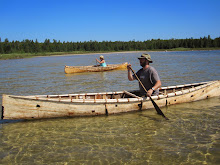
 This was the launching of the North Star Spring of 2010. I think this picture has 3 adults and about 14 kids riding in the canoe and there is still plenty of freeboard! These boats were designed to haul lots of gear!
 

Here is a picture of my son Matt and I in the canoe at the launch. I would like to thank Kevin, Patrick and Mr. G. at the Goodwillie School for letting us hang out and help out with the build.
 

Thursday, September 2, 2010

Nature's Garden book and New Foragers Harvest dvd

"Nature's Garden" is Sam Thayer's newest book and follows the same format as his first book "The Foragers Harvest". This is another top quality go to book on wild edibles. This book covers 41 new edibles with the same no nonsense, hands on, I really eat this stuff manner. Both of Sam's books have quickly become favorites of experienced and novice foragers alike. This book will be a valuable asset to any foragers library.

New Foragers Harvest DVD set. Im really excited to check out this dvd set to go with the book the foragers harvest. If it is anything like his books then it should be one of the best plant videos around..cant wait to get em...This is the info from his site and a link to the video trailer ....


 http://www.youtube.com/watch?v=snpAZybSkn4


DVD case cover
The Forager’s Harvest DVD Set includes two discs covering all the plants discussed in my first book. The footage was shot by Brian Pierce over the course of three years as he accompanied me on foraging adventures. Through hundreds of hours of editing, organizing, re-shooting, and planning in order to optimize the usefulness of the video to viewers, Brian created excellent DVDs that are both informative and fun. The entire production is narrated by me (Samuel Thayer) and provides ample ammunition for those who wish to make fun of my mannerisms, hairstyle, and especially, my attire choices. It also contains real-life footage of gathering and eating from the wild. In it, we interrupt normal foraging antics to cover the bases regarding each plant: identification, where to find it, what stage to harvest it in, what parts to collect, how to get them, and how to use them.
If you are a forager who prefers watching film to reading, or if you just want to augment the descriptions and explanation offered in The Forager’s Harvest, this video is for you. If you want to see what tangled clumps of hopniss vines and Siberian elms loaded with green seeds look like in real live action, they’re here. If you want to see the process of harvesting wild rice from a ripe bed, then parching, dancing, and winnowing it, it’s on film here. This footage captures the abundance, surprise, bounty, beauty, blind luck, mosquitoes, wood ticks, and occasional frustrations of wild food gathering in all kinds of settings around the Midwest, from wilderness lakes and hardwood forests to backyards and empty lots.